Garage Door Off Track Repair in Cookeville, TN
Work starts by holding the door steady. Then it is worked back onto its rails, re-hung on straight track with good rollers, and the original cause is corrected.
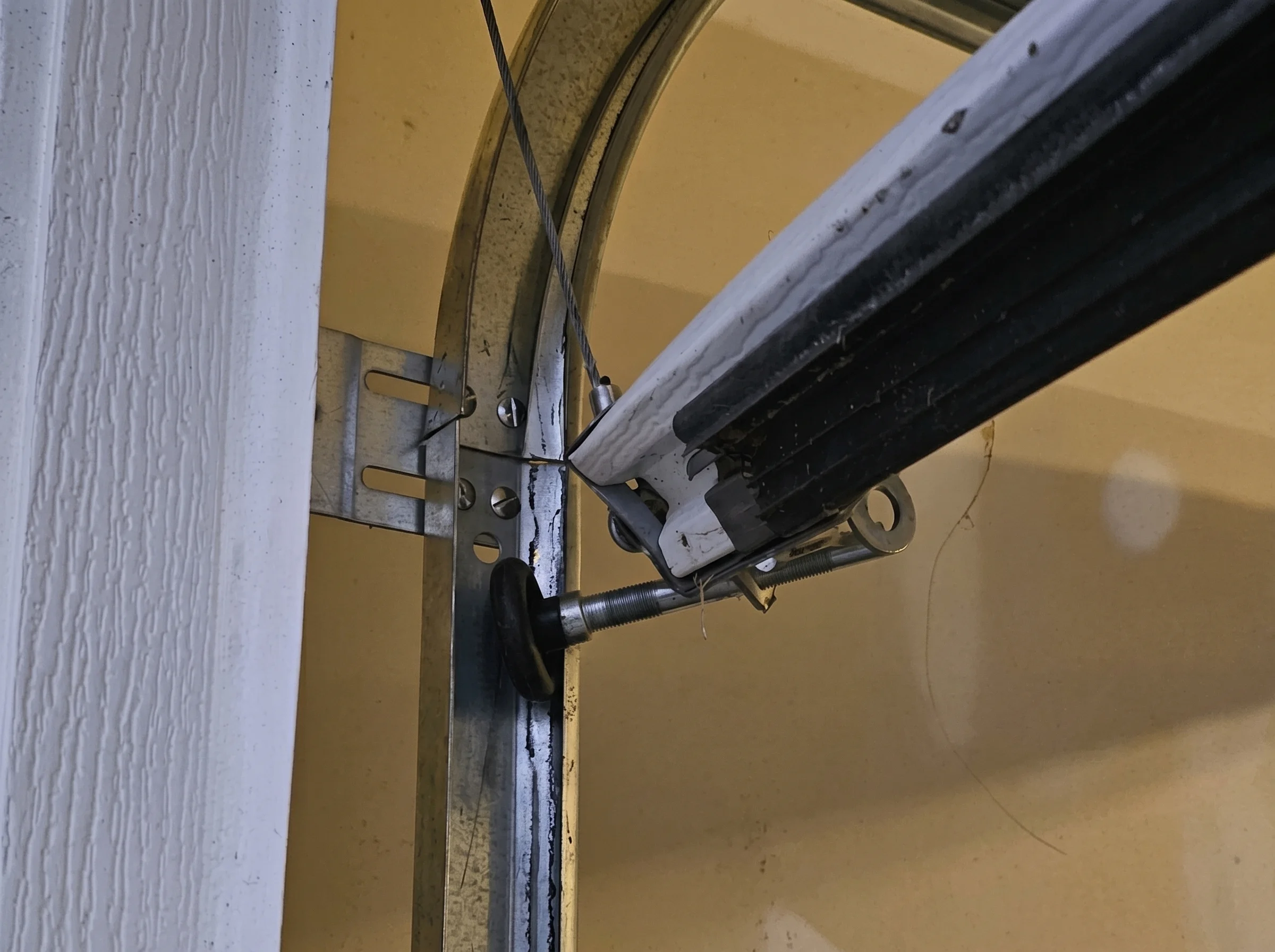
Your garage door in the Cookeville area is off track if rollers have left the rail, if the door is cocked or stuck, or if a panel bent where it caught. Do not use it, and do not run the opener, not even once.
How to recognize a derailed door
One or more rollers sitting beyond the rail, most commonly at the foot of the door or where the track bends upward toward the ceiling.
A tilted or jammed door, often stuck halfway up.
A crease or bow in one panel, from the opener pressing on a jammed door.
Rail that looks bent, dented, or peeling away from the framing.
Scraping, popping or grinding in the final cycles before it let go.
After a derailment, skip the opener, and tell us which side popped out and what led up to it.
Contact UsWhat knocks a door off the rail
A car or truck bump
Backing a car into a closed or half-open door is the top cause, and it tends to bend the bottom of the rail as well.
A cable that broke or slid off
A corner sags, the door twists, and wheels pop loose. For a slack cable, see cable repair for that half of the problem.
Tired or cracked rollers
A roller whose bearing locks up drags along the rail instead of rolling, then jumps at the first bump.
Slack or warped rail
Vibration over the years works the wall brackets loose, which lets the rail spread wider until a roller finally falls free.
An obstacle underneath
Trash bins, bikes and mowers left in the way get crushed as the door closes, worse when the opener pushes too hard.
Secure the area
Keep the opener off
Running it worsens the damage: panels buckle and the rail pulls off its fasteners.
Do not tug the emergency release with the door open part way and derailed; it might fall or come loose from the rail completely.
No hammering rollers into place on a loaded door. Spring tension is still pulling on a derailed door, so it can jerk sideways or drop.
Keep your distance, and say so at once if a car is shut inside the garage.
How the fix goes
The door is propped and clamped before anything else, and any spring tension is released or controlled where necessary.
Damage gets sized up
The inspection covers failed rollers, rail damage, creased panels, and whether a cable or spring started it.
Rail is reshaped or swapped
Slight bends are pulled true; creased or torn lengths get replaced.
Damaged rollers are exchanged and each hinge examined, because one cracked hinge is enough to throw a roller off again.
Rollers go back in the rails, track brackets are cinched, and the door travels through full cycles under power. Last, the opener's limits and force are verified.
Describe what happened
Two or three sentences will do for a start. No need to know the names of anything that broke.
Rollers
A door's smoothness and noise level come from its rollers, which give out long before the panels and track do.
Bare steel rollers are noisy and chew the rail; Cookeville's 60 inches of yearly precipitation rusts them too.
Sealed-bearing nylon rollers spin much more quietly and rarely need oil or grease.
A wobble, a flat spot, a cracked wheel or a locked bearing flags a roller for replacement.
Mostly noisy rather than damaged? New rollers may be nearly all it needs, and a maintenance visit is a typical time to fit them.
What moves the price of this repair
How badly it came out
Two rollers on one side, or an entire door dangling.
Rail damage
Rail reshaped or sections replaced, on one side or both.
Worn rollers and hinges that must go.
Creased or split panels
A badly warped panel may have to be replaced, and an older door's panel is hard to match.
A cable or spring fault that started the derailment.
When the panel cannot be rescued
A hard hit can leave panels past the point of straightening. A single panel can often be swapped if a match is still sold, and the City of Cookeville Codes Division lists building repairs among permit work.
With no matching panel, or several damaged, garage door installation goes through new door choices.
Frequent questions
May I tap one roller back in without help?
Only in one narrow case: a single roller has dropped out low on a shut door, and the rail and cables are intact. Otherwise, step away. A door like this is heavy, wound up with spring force, and capable of moving suddenly.
What makes the left or right side derail repeatedly?
The typical culprits are a slightly twisted rail, a track bracket that came loose, or a cable on that side that has lost its adjustment. Hanging the door again without removing that culprit invites a repeat.
Do the rails need oil?
No. A rail should stay clean and dry because any oil on it traps grit. Save the lubricant for roller bearings, hinges and springs.
More garage door services
Garage Door Cable Repair
Lift cables that wear through or slip free, and doors left sagging.
See details →Garage Door Spring Repair
Springs that snap, torsion or extension, swapped for a set rated to carry your door.
See details →Garage Door Installation
New doors made from steel, wood, composite or glass, ordered to match the opening.
See details →Reach out
Let us know whether the door ended up closed, open or midway, which side let go, and what, if anything, struck it.
Back up a few feet and photograph each side. For bigger jobs, check any contractor with the Tennessee Board for Licensing Contractors.