Garage Door Spring Repair in Cookeville, TN
Spring repair around Cookeville means a new spring sized to carry your specific door, with the door left balanced so the opener, and your arm, just steer it.
A boom from the garage and a door that stays put, or lifts a few inches then quits, almost certainly means a spring has let go. Leave the door closed and keep reading before touching it.
Clues a spring broke
A sudden boom from the garage, often when nobody is around. With the door closed, a torsion spring is under the greatest tension, which is why many give way at that moment.
A visible break
Check the bar above the shut door. A broken torsion spring leaves a clean separation, sometimes a few inches across.
The door feels suddenly heavy, or drifts down when you let go of it midway.
The opener labors and hums, or the door rises a hand's width and halts
Many openers detect the added load and reverse, so it can look like the opener has failed.
The door lifts unevenly, one side ahead of the other. With a spring on each track, that means one has lost its tension.
The door falls hard through the last foot rather than easing down.
Heard a bang and the door won't rise? Don't move it, and tell us what the area above the door looks like.
Contact UsPrecautions while you wait
Torsion springs store enough force to break bones, and once one fails the door hangs on whatever else is holding it. Until it has been repaired properly:
Don't haul the door up by hand or keep jabbing the opener button
The motor isn't made to lift that much weight, and keeping at it can strip its gears.
Leave the emergency release alone if the door is up
Without spring support the whole weight of the door can drop at once.
Never attempt to wind or adjust a torsion spring
The winding cones are where the energy is held, and where this trade's worst injuries happen.
Keep kids and pets well away from the door, and park somewhere else if it's stuck partly open.
Mention it when you call if a vehicle is trapped inside.
Two spring designs and how they differ
Torsion springs ride on a steel shaft above the door and store energy by twisting, turning the drums that take up the cables.
Most doors built lately have them. They lift smoother than extension springs, and when one breaks it's less hazardous, as the pieces stay put on the shaft.
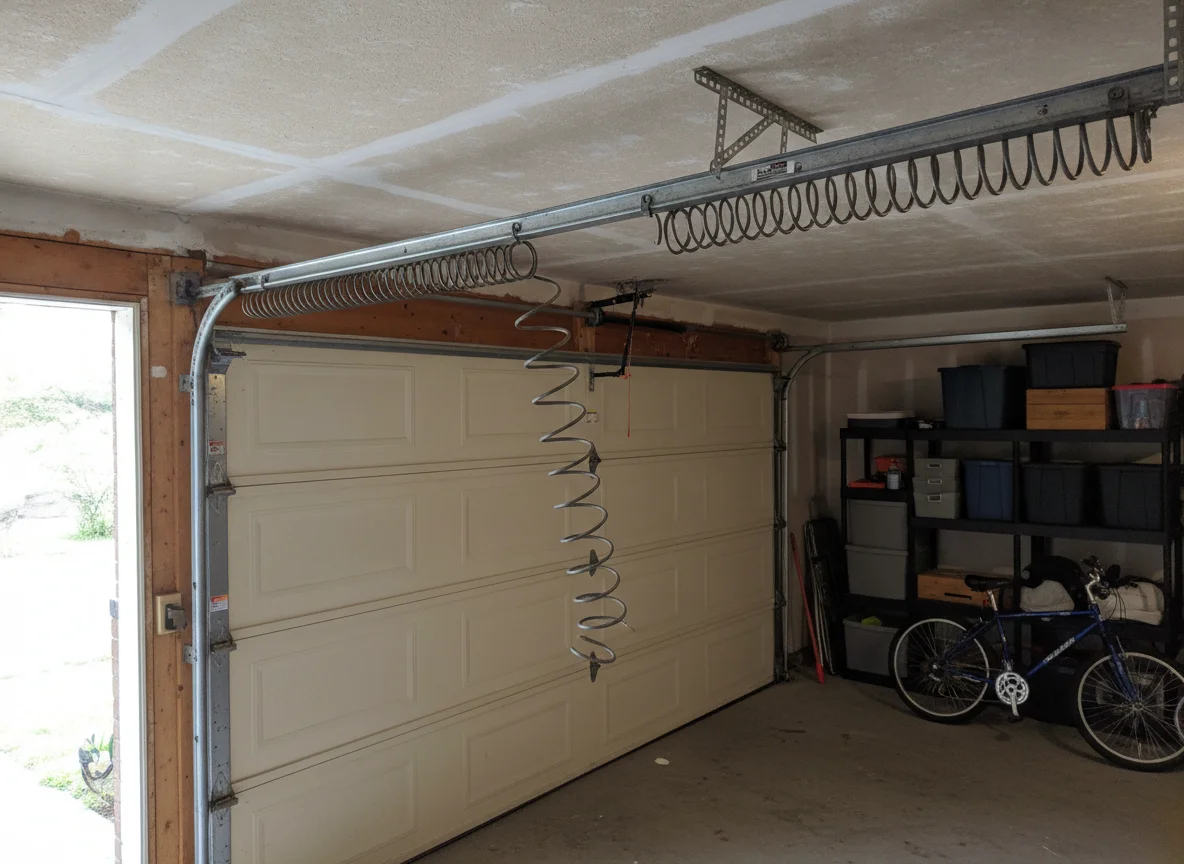
Extension springs are mounted alongside each horizontal track and stretch as the door lowers. They show up on older, lighter doors. A safety cable must pass through every one, or a broken spring can whip across the garage and cause real damage.
A spring with no cable through it should be fixed even if nothing has snapped yet.
Most older extension-spring doors can convert to torsion; if you ask about it, verify any contractor through the Tennessee Board for Licensing Contractors.
How a spring job unfolds
Step one: pinpoint and measure the broken spring
Wire gauge, inner diameter, length and winding direction are measured. A wrong guess on any one leaves the door unbalanced.
The weight of your door picks the spring
The right spring is whichever one matches your door's weight, not whatever is nearest.
The broken spring is removed carefully, with its tension relieved before any bolt is loosened.
The new spring is installed and tensioned, and the drums and cables are examined to make sure both sides rise together.
Balance check and test runs
Disconnect the opener and the door should hold about where you leave it at waist height; reconnected, it should open and close smoothly.
Say what the door is doing
A couple of lines is plenty to get going; the broken part's name isn't something you need to know.
Replace one or two?
Two springs share one door, so they've logged identical cycles. Once one snaps, the second is often close to the end as well.
Swapping the pair together saves a return trip and keeps the lift even, since a fresh spring beside a worn one pulls harder on its side.
Ask what they'd advise for your door, and their reasoning. On a one-spring door, find out if a second spring would give a more even lift.
What affects the spring repair bill
Torsion or extension, with one spring or two on torsion.
How big and heavy it is
A double-wide, solid wood or thick insulated steel door needs heavier springs than a basic light door.
Rated lifespan in cycles
Springs come rated for a certain number of open-and-close cycles. More cycles in the rating means a higher price, but it pays off on a door that is used all day long.
Other worn parts
Cable ends fraying at the drums, rollers that have been dragging, or worn bearings at the end of the shaft are less costly to replace now than on a later trip.
Switching from extension springs to torsion, should you decide to.
What's a spring's normal lifespan?
Usage outweighs age. Cycle-rated springs last years longer on a door used a handful of times a day than on one that is the household's daily front entrance, where every trip adds a cycle.
Cookeville's record low is -22 F, and cold strains spring steel, which is why many springs snap on the first hard-freeze mornings.
Springs that failed earlier than expected? Ask about a spring with a higher rating.
The added cost tends to be small beside paying for a second repair.
If it's not the spring
The spring looks whole, but the door sags to one side or a cable hangs
Go to garage door cable repair.
Nothing snapped, yet the door groans or crawls
A maintenance visit catches worn springs before they let go.
Typical questions
Is changing a spring a DIY project?
Some homeowners handle extension springs, provided safety cables are installed and the door is fully raised and clamped.
Torsion springs are different. They need proper winding bars and the exact spring specs, and one slipped bar sends the stored energy straight into your hands. Of all garage door repairs, this is the one where paying a professional is about safety, not just ease.
How do I get my car out of the garage?
Not safely, so don't try. Leave the door shut and tell us about the car when you contact us.
Why did the spring snap when nobody touched the door?
Every cycle wears a spring a little, and a closed door leaves a torsion spring wound tightest. The last fatigue crack often gives way then, and cold makes the steel brittle; Cookeville sees about 6 inches of snow a year.
Do I need a new opener after a spring swap?
Seldom. If the opener spent time straining against the broken spring, though, have its gears checked for stripping.
Also see these pages
Garage Door Cable Repair
Worn, broken or off-drum lift cables and doors that hang unevenly.
Read more →Garage Door Opener Repair
Openers that buzz, back up or go silent, plus replacements when a repair isn't sensible.
Read more →Garage Door Maintenance
Planned inspections of springs, cables, rollers and reverse function, ahead of any breakdown.
Read more →Contact us
Is it a single or double door? Say what you heard, whether anything moves, and if a car is stuck inside.
A floor-level photo of the spring bar over the closed door shows the spring type and the break, and is well worth taking before you call.